Every six months, the Cabinet announces a DA revision and the number appears in newspapers, WhatsApp forwards, and government circulars. But most employees simply accept it — few understand how the percentage is actually derived. This guide explains the exact formula, walks through the math, and tells you what to expect when July 2026 rolls around.
Current DA rate: 60% of Basic Pay, effective January 2026. The next revision is due from July 2026, to be announced and made effective likely in September–October 2026.
The AICPI Index: The Engine Behind DA
DA is not decided by political will or budget availability. It is mechanically computed from the All India Consumer Price Index for Industrial Workers (AICPI-IW), base year 2001=100. This index is published monthly by the Labour Bureau and tracks the cost of a fixed basket of goods — food, clothing, housing, fuel, and miscellaneous items — across 78 industrial centres in India.
When prices rise, AICPI rises, and DA rises proportionally. When prices fall (deflation), DA can theoretically fall — though in practice, DA is never reduced even if the formula produces a lower number, it just stays flat.
The DA Formula for Central Government Employees
The formula prescribed by the 7th Pay Commission is:
DA% = [(Average AICPI for past 12 months ÷ 261.42) – 1] × 100
Where 261.42 is the index value corresponding to the base month of the 7th CPC (July 2016). The 12-month average is calculated differently for January and July revisions:
- January revision: Average of AICPI from July to June (previous year)
- July revision: Average of AICPI from January to December (previous year)
How the Current 60% DA Was Arrived At
For the January 2026 DA revision, the government averaged the AICPI-IW figures from July 2024 to June 2025. The average index came to approximately 418.57. Applying the formula: (418.57 ÷ 261.42) – 1 = 0.601, or roughly 60.1%, rounded down to 60%. The final DA is always announced as a whole number.
| Revision Period | DA % | Effective From |
|---|---|---|
| January 2024 | 50% | 01 Jan 2024 |
| July 2024 | 53% | 01 Jul 2024 |
| January 2025 | 55% | 01 Jan 2025 |
| July 2025 | 58% | 01 Jul 2025 |
| January 2026 | 60% | 01 Jan 2026 |
| July 2026 (projected) | 63–64% | 01 Jul 2026 |
What to Expect in July 2026
The AICPI data from January to December 2025 will determine the July 2026 DA. Based on published index figures up to December 2025, the 12-month average is trending toward 426–428. Applying the formula, this gives a DA of approximately 63–64%. The Cabinet announcement usually comes in September or October, but the DA is effective from July 1 — which means employees receive 3 months of arrears in one shot when it's declared.
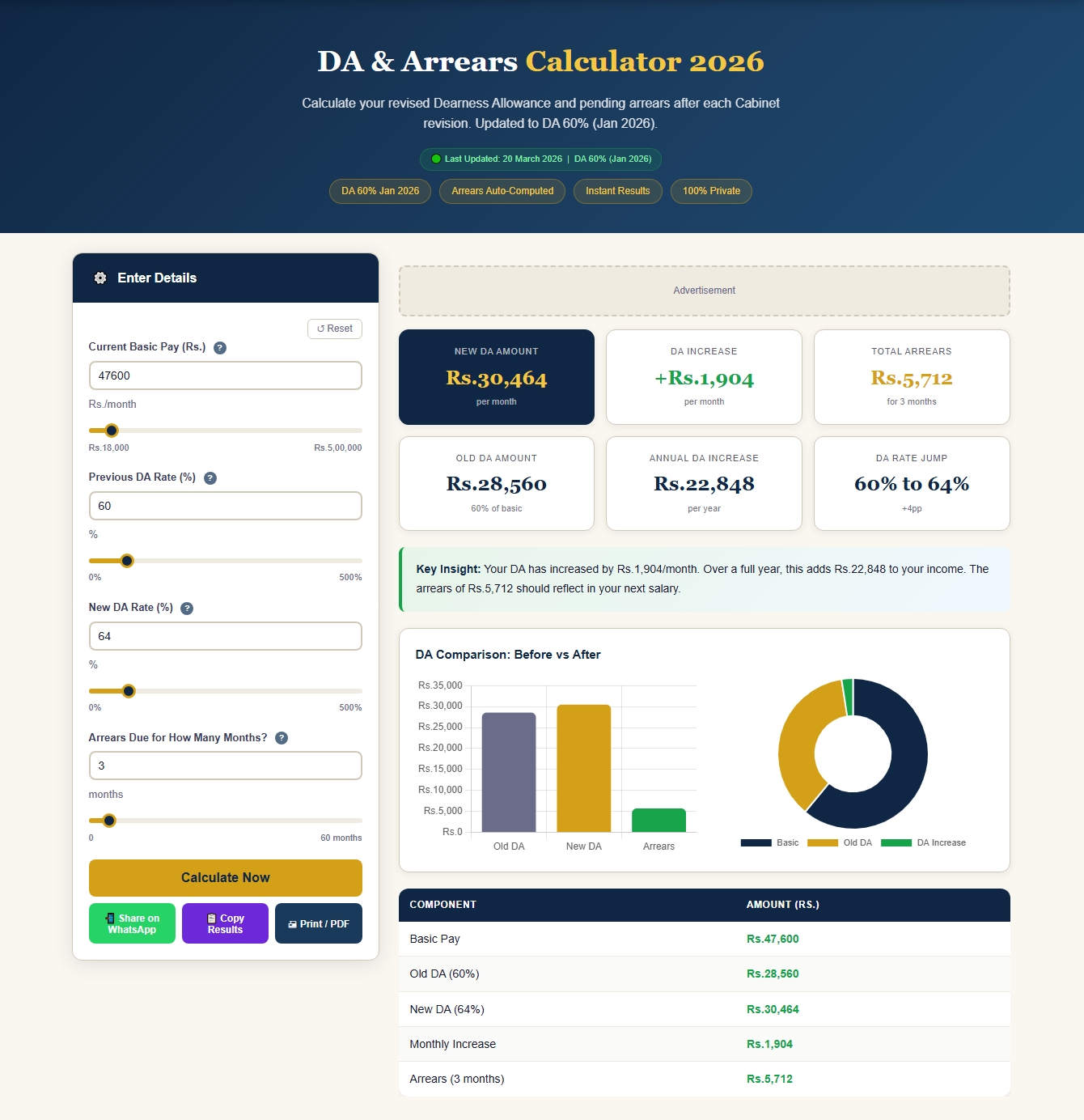
For a Level 7 employee with Basic Pay of Rs. 47,600, a jump from 60% to 64% DA means an additional Rs. 1,904 per month — or Rs. 5,712 in arrears when the announcement hits.
📈 Calculate Your DA Arrears
Enter your Basic Pay and the old vs new DA rate to compute your exact monthly increase and total arrears.
How DA Arrears Are Paid
When the Cabinet revises DA mid-year, it is always made effective from July 1 (or January 1). By the time the circular reaches your DDO and the salary system is updated, 2–3 months have already passed. Those months' additional DA is accumulated and paid as a lump sum arrear — typically in the month the revised salary is processed.
This arrear is fully taxable as salary income in the year it is received. Some employees opt to spread it using Form 10E to claim relief under Section 89(1) of the Income Tax Act — which can reduce the tax hit significantly if the arrear pushes you into a higher tax bracket.
DA on TA and Other Allowances
DA is not just added to your Basic Pay — it also has a cascading effect. Transport Allowance includes a DA component: TA itself attracts DA at the same rate as Basic Pay. So when DA rises from 60% to 64%, your effective TA also increases slightly. Some special allowances also carry DA, though most post-7th CPC allowances have been rationalised to fixed amounts.
The July 2026 Announcement: Why You Need to Prepare Now
The DA announcement in September or October 2026 will be the single biggest traffic event for government salary information this year. If you have colleagues asking about their revised pay, the DA Calculator lets anyone compute their revised take-home and arrears in under a minute — no spreadsheet required, no manual calculation.
Bookmark it now. Share it with your department's WhatsApp group before the announcement. When the circular drops, everyone will be reaching for a calculator.
Frequently Asked Questions
Can DA ever go down?
In theory, yes — if AICPI falls, the formula would produce a lower DA. In practice, the government has a convention of not reducing DA even if the formula produces a marginally lower number. DA has not been reduced since the 7th CPC was implemented.
Is DA different for pensioners?
Pensioners receive Dearness Relief (DR) at the same percentage as DA, announced simultaneously. The calculation formula is identical. DR is paid on the basic pension amount.
Does DA affect my income tax?
Yes. DA is fully taxable and is included in gross salary for TDS computation. Unlike HRA, there is no exemption on DA. Check your TDS monthly — as DA rises, many employees cross the tax slab thresholds mid-year without realising it.