The 8th Central Pay Commission has been formally constituted. For 50 lakh Central Government employees and 65 lakh pensioners, the questions are the same ones that surfaced in 2014 when the 7th CPC was set up: What is the fitment factor going to be? When does it take effect? And what will Level 7 actually earn after revision?
Here's what we know for certain, what's speculation, and how to project your own revised salary using historical patterns.
What's confirmed: The 8th CPC has been constituted (January 2025 Cabinet announcement). It is expected to submit its report by December 2025 or early 2026, with implementation targeted for January 2026 — though delays are common. The 7th CPC was constituted in February 2014 and implemented in January 2016, with arrears paid later that year.
Understanding the Fitment Factor
The fitment factor is the multiplier applied to your current Basic Pay to arrive at your new Basic Pay under the revised structure. The 7th CPC used a fitment factor of 2.57 — meaning a Level 1 Basic Pay of Rs. 7,000 (6th CPC) became Rs. 18,000 (7th CPC). Every level was multiplied by the same factor and then fitted to the nearest Pay Matrix cell.
For the 8th CPC, staff associations have demanded a fitment factor of 2.86. Independent analysts using AICPI-based projections estimate 1.92 to 2.28. The actual number will be the Commission's recommendation, which the Cabinet may accept, modify, or delay.
Historical Fitment Factors: The Pattern
| Pay Commission | Fitment Factor | Effective From | Arrears Paid |
|---|---|---|---|
| 5th CPC | ~1.40 | 01 Jan 1996 | 1997 |
| 6th CPC | ~1.86 | 01 Jan 2006 | 2008 |
| 7th CPC | 2.57 | 01 Jan 2016 | 2016 |
| 8th CPC (projected) | 1.92–2.86 | 01 Jan 2026 | 2026–2027? |
Projected New Basic Pay by Level
Using a conservative fitment of 1.92 and an optimistic fitment of 2.57 (same as 7th CPC), here are projections for key levels based on the minimum Basic Pay at Stage 1:
| Pay Level | Current Basic (Stage 1) | At 1.92x | At 2.28x | At 2.57x |
|---|---|---|---|---|
| Level 1 | Rs. 18,000 | Rs. 34,560 | Rs. 41,040 | Rs. 46,260 |
| Level 4 | Rs. 25,500 | Rs. 48,960 | Rs. 58,140 | Rs. 65,535 |
| Level 6 | Rs. 35,400 | Rs. 67,968 | Rs. 80,712 | Rs. 90,978 |
| Level 7 | Rs. 44,900 | Rs. 86,208 | Rs. 1,02,372 | Rs. 1,15,393 |
| Level 10 | Rs. 56,100 | Rs. 1,07,712 | Rs. 1,27,908 | Rs. 1,44,177 |
| Level 13 | Rs. 1,23,100 | Rs. 2,36,352 | Rs. 2,80,668 | Rs. 3,16,367 |
🆕 Project Your 8th CPC Salary
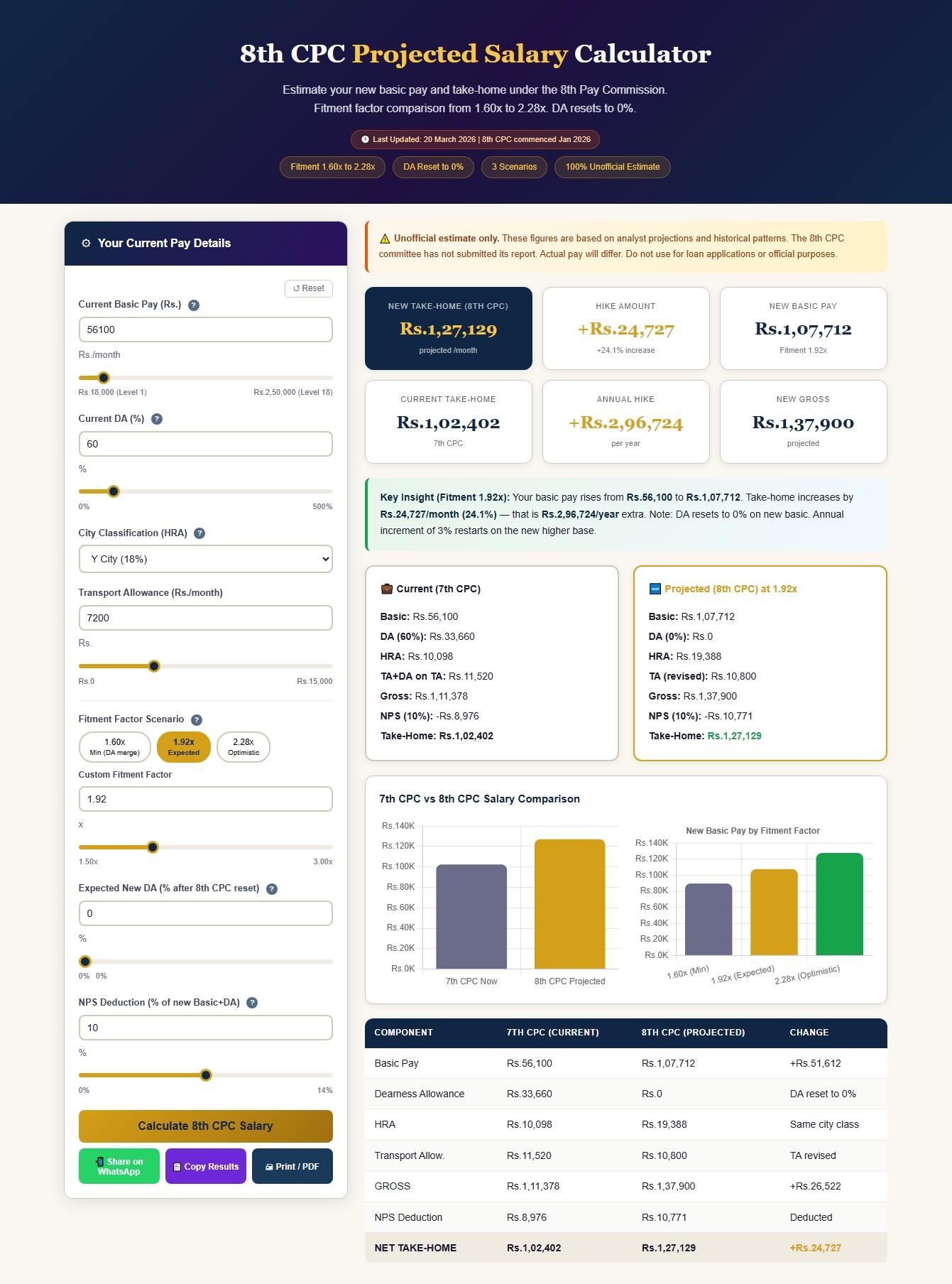
Enter your current Basic Pay and choose a fitment factor scenario to see your projected revised salary instantly.
What Happens to DA After Implementation?
When the 8th CPC is implemented (say, from January 2026), the DA at that point — projected to be around 65–70% by then — is merged into the new Basic Pay as part of the fitment. The new Basic Pay already incorporates this DA merge. Post-implementation, DA reverts to 0% and starts accumulating again from the new base. This is the standard pattern followed in every Pay Commission cycle.
This means the jump from current Basic Pay to 8th CPC Basic Pay isn't just the fitment factor — it also bakes in the accumulated DA. The effective increase in take-home salary may feel less dramatic because DA goes to zero, even though Basic Pay rises significantly.
The Arrears Question
If 8th CPC is effective from January 2026 but implementation orders come in mid-2026, employees will be entitled to arrears for the intervening months. Based on the 7th CPC experience, arrears were paid in August 2016 for a January 2016 effective date — about 7 months of arrears in one payment. That was a significant amount for most employees.
For the 8th CPC, the arrear payout will depend on how quickly the report is submitted and how quickly the government processes it. Watch for the formal gazette notification — that's when the effective date is confirmed.
What to Do While You Wait
The best thing to do between now and implementation: use our 8th CPC Projected Salary Calculator to model different scenarios, and start thinking about your financial plan for the arrear payout. Historically, many employees spend arrears immediately. A smarter move is to route a significant portion into NPS Tier-II or index funds — the one-time lump sum can meaningfully accelerate your retirement corpus.
Frequently Asked Questions
Will pensioners also benefit from 8th CPC?
Yes. Pension revision follows salary revision — pensioners get a revised pension based on the new pay matrix corresponding to their last pay drawn. Dearness Relief (for pensioners) also resets to 0% when the new structure takes effect, and then builds up again.
Is there any chance of 8th CPC being delayed beyond 2026?
Historically, every Pay Commission has been delayed by 1–2 years from its target implementation date. The 7th CPC was implemented 6 months after the constituted timeline. A 2027 effective date for 8th CPC is not impossible, particularly if the Commission report is delayed or the government needs time to study it. Arrears would be paid retroactively to January 2026 regardless.