Every month, lakhs of Central Government employees receive their salary slip and struggle to reconcile the numbers. Basic Pay they know. But DA, HRA, TA — how do those get calculated? And why does the final take-home feel lower than expected? This guide answers all of that, step by step, with a real worked example you can follow along with.
Quick fact: As of January 2026, DA stands at 60% of Basic Pay. This is the most significant component after Basic Pay and has a compounding effect — it also increases your HRA base indirectly through AICPI adjustments.
Understanding the Pay Matrix: Your Starting Point
The 7th Pay Commission replaced the old Grade Pay system with a Pay Matrix — a grid where your Pay Level (1 to 18) and your increment stage (1 to 40) determine your exact Basic Pay. A Level 7 employee at Stage 5, for instance, draws Rs. 50,500 as Basic Pay. There is no ambiguity, no negotiation — the matrix is a published government document and every DDO refers to the same table.
If you want to look up your exact Basic Pay, use our Pay Matrix Table — it covers all 18 levels with every stage value.
The Gross Salary Formula
Once you have your Basic Pay, the calculation follows a fixed structure:
Gross Salary = Basic Pay + Dearness Allowance (DA) + House Rent Allowance (HRA) + Transport Allowance (TA) + Other Allowances
Let's walk through each component.
Dearness Allowance (DA)
DA is revised twice a year — in January and July — by the Cabinet, based on the All India Consumer Price Index (AICPI). As of January 2026, it is 60% of Basic Pay. For a Basic Pay of Rs. 47,600 (Level 7, Stage 4), the DA component works out to Rs. 28,560 per month. This is a significant chunk — nearly as large as the basic pay of a Level 1 employee.
House Rent Allowance (HRA)
HRA depends entirely on which city classification your posting falls under. The 7th CPC classifies cities into three tiers:
- X Class (27%): Delhi, Mumbai, Chennai, Kolkata, Hyderabad, Bengaluru, Ahmedabad
- Y Class (18%): State capitals and cities with population above 5 lakh
- Z Class (9%): All other postings
For our Level 7 employee in a Y-class city: HRA = 18% of Rs. 47,600 = Rs. 8,568. Note that HRA is calculated on Basic Pay only — DA is not included in the HRA base under 7th CPC rules.
Want to calculate your exact HRA with the three-rule tax exemption comparison? Use our HRA Calculator.
Transport Allowance (TA)
TA was revised upward after 28% DA crossed the threshold. For Level 7 and above in a major city, it currently stands at Rs. 3,600 per month plus DA on TA. For smaller cities and lower levels, it ranges from Rs. 1,350 to Rs. 7,200. Check your actual entitlement with your DDO, as this depends on both pay level and city.
🎉 Calculate Your Exact Take-Home
Enter your Basic Pay, city class, NPS %, and other details to get your complete salary breakdown instantly.
Worked Example: Level 7 Employee, Y-Class City, January 2026
Let's put numbers to everything. Assume Basic Pay = Rs. 47,600, posting in a Y-class city, NPS contribution at 10%, CGHS at Rs. 350/month, no TDS (under the exemption threshold).
| Component | Amount (Rs.) | Basis |
|---|---|---|
| Basic Pay | 47,600 | Pay Matrix Level 7, Stage 4 |
| Dearness Allowance | 28,560 | 60% of Basic Pay |
| HRA | 8,568 | 18% of Basic Pay (Y Class) |
| Transport Allowance | 3,600 | Fixed for Level 7 |
| Gross Salary | 88,328 | |
| NPS Employee (10%) | –7,616 | 10% of Basic + DA |
| CGHS Contribution | –350 | Fixed as per category |
| Net Take-Home | 80,362 |
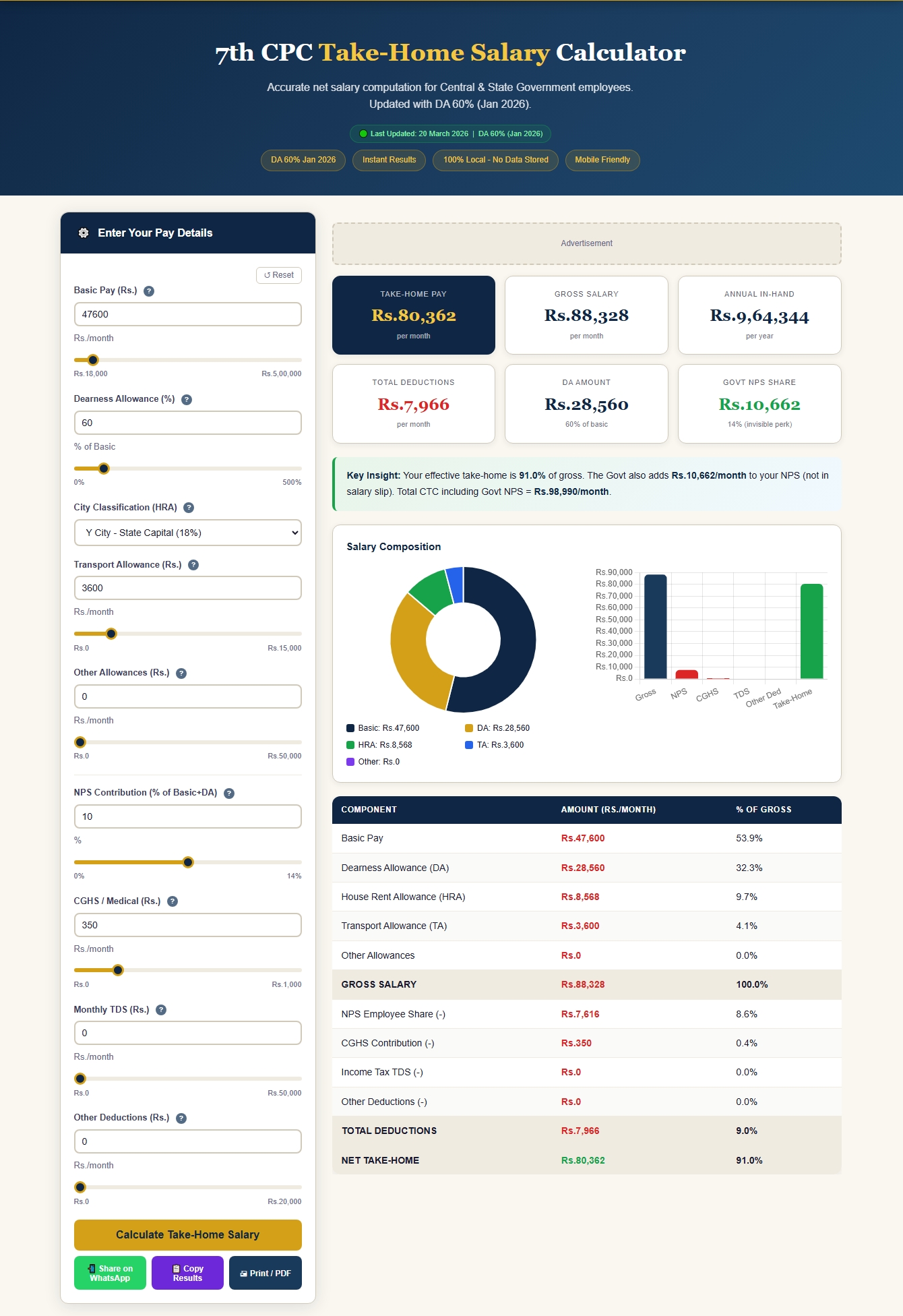
The hidden perk most employees miss: Your employer (the Government) also contributes 14% of Basic + DA to your NPS account — Rs. 10,663/month in this example — that doesn't appear anywhere on your salary slip. Your actual CTC is Rs. 88,328 + Rs. 10,663 = Rs. 98,991. This matters enormously for retirement planning.
Key Deductions Explained
NPS Employee Contribution
For all Central Govt employees recruited after January 1, 2004, NPS is mandatory. The employee contributes 10% of Basic + DA, and the government contributes 14%. The combined 24% goes into your NPS Tier-I account and is invested in a mix of equities, government securities, and corporate bonds based on your choice of fund manager and scheme. Use our NPS Pension Calculator to project what your corpus and monthly pension might look like at retirement.
CGHS Contribution
The Central Government Health Scheme contribution is Rs. 350/month for employees in pay Band 1 and 2 (roughly up to Level 8), and higher for senior officers. This is a fixed deduction and doesn't depend on your Basic Pay.
Income Tax (TDS)
Whether you pay TDS depends on your total taxable income and which tax regime you've chosen. A Level 7 employee earning around Rs. 10 lakh annually often falls on the edge — the old regime with Section 80C, 80D, and HRA exemptions can reduce taxable income significantly. Our Income Tax Calculator lets you compare both regimes side by side.
How to Use the Calculator for Your Situation
The best way to use the 7th CPC Salary Calculator is to start with your actual Basic Pay from your latest salary slip — not your assumed level. Many employees are surprised to find their Basic Pay has moved to a higher stage after annual increments. Enter the exact figure, select your city class, input your actual NPS percentage (some opt for more than the mandatory 10%), and add any arrears or special allowances under "Other Allowances."
The result shows not just take-home, but also the percentage breakdown between gross and deductions — useful for financial planning, loan applications, and income tax declarations.
Frequently Asked Questions
Is DA included in the HRA base calculation?
Under the 7th CPC, HRA is calculated only on Basic Pay. DA is not included in the HRA base. This is different from some State Government rules, so always verify if you're comparing across government structures.
What happens to my salary when DA crosses 50%?
When DA crosses the 50% threshold (which happened in July 2024 at 50%, and January 2025 at 53%), city allowances like TPTA and some other fixed components are revised upward. The 60% DA you receive now already incorporates those revisions.
How often should I recalculate my salary?
Recalculate every January and July when DA is revised, and every July 1 when your annual increment kicks in. If you have a promotion or MACP upgrade, recalculate immediately.